
Edge AI and TinyML: How Intelligence Moves Directly onto Devices
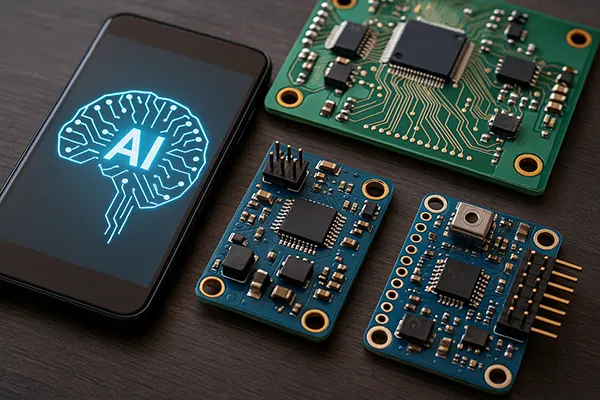
Edge-level artificial intelligence has become one of the most significant technological shifts of the mid-20200s. Instead of relying solely on cloud processing, AI models are increasingly executed directly on smartphones, embedded boards, and compact IoT sensors. This transition reshapes expectations around speed, autonomy, data protection, and energy efficiency, and it is already influencing industry workflows, consumer electronics, and public infrastructure.
The Rise of On-Device Intelligence
The shift towards local processing is driven by the constant need to reduce delays and ensure stable performance, especially in environments where connectivity is unpredictable. Executing models directly on the device removes the dependence on remote servers, which is crucial for industrial automation systems, connected vehicles, and modern health monitoring tools. With on-device AI, even simple battery-powered sensors gain the capability to analyse signals in real time.
Another key motivation behind this movement is user confidentiality. When data processing occurs inside the device, sensitive information does not leave the local environment. This approach benefits financial tools, biometric authentication, medical monitoring, and consumer gadgets where privacy concerns remain high. The ability to handle personal data without transmitting it elsewhere significantly improves trust in the system.
On-device AI has also become feasible thanks to the rapid improvement of specialised processors. Neural engines integrated into smartphone chipsets, efficient microcontrollers compatible with TinyML models, and compact accelerators designed for IoT allow complex calculations while consuming minimal power. These devices create a balance between performance and consumption that was impossible a decade ago.
Practical Benefits of Edge-Level Computation
One of the most noticeable advantages is the reduction in response time. Whether it concerns voice assistants, gesture recognition modules, or predictive maintenance sensors, the ability to act instantly without contacting remote servers enhances reliability. In safety-critical environments such as robotics or machinery control, this responsiveness directly influences operational safety.
The next benefit concerns resilience. By removing the reliance on permanent connectivity, devices continue operating even in areas with weak or unstable networks. Farms using environmental sensors, wearable devices for professional athletes, or remote industrial stations maintain consistent performance without the risk of interruption.
Another important advantage is cost optimisation. Executing AI locally lowers cloud usage fees and reduces bandwidth consumption. For businesses deploying thousands of IoT sensors, this shift significantly decreases operational expenses while maintaining consistent analytical capabilities across the entire system.
TinyML: Enabling Machine Learning on Ultra-Low-Power Devices
TinyML represents a specialised direction that focuses on running compact machine learning models on microcontrollers with extremely limited resources. These chips typically operate with kilobytes of memory but remain capable of performing tasks such as audio classification, anomaly detection, and environmental monitoring. The discipline has matured quickly, supported by optimised frameworks and dedicated hardware.
The essence of TinyML lies in redesigning models to fit restricted environments. Techniques such as pruning, quantisation, and architecture simplification allow engineers to create versions of neural networks that preserve essential accuracy while operating with minimal computational load. As a result, devices powered by small batteries or even energy-harvesting systems gain analytical capabilities.
Today, TinyML is widely deployed in smart building infrastructure, environmental stations, and wearable health tools. These use cases benefit from prolonged battery life and the ability to process complex signals directly at the point of collection. Recent advances in low-power wireless standards complement TinyML, enabling real-time insights without overwhelming communication channels.
Where TinyML Is Already Making an Impact
In industrial contexts, microcontroller-based systems monitor vibrations, temperature shifts, or acoustic patterns to predict equipment faults before they escalate. Running inference locally ensures that alerts are generated instantly, avoiding damage and reducing downtime. These models operate continuously while consuming less energy than traditional hardware.
In healthcare and wellness technology, miniature wearables equipped with TinyML detect irregular heart rhythms, breathing patterns, or movement anomalies. The ability to interpret raw signals locally avoids unnecessary data transmission and extends device autonomy, which is essential for continuous monitoring applications.
Public infrastructure also benefits from TinyML. Smart lighting systems adjust brightness based on motion analysis, environmental sensors track pollution levels, and environmental probes assess air quality in remote areas. Local processing ensures high-frequency sampling without saturating network bandwidth.
Challenges and Engineering Constraints
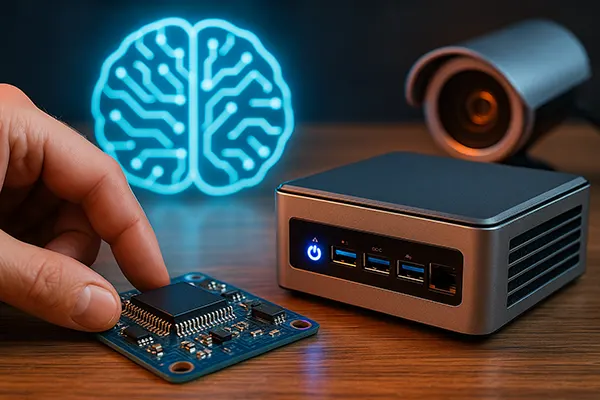
Despite impressive progress, on-device AI faces technical obstacles. Running advanced models locally requires careful balancing between performance, thermal restrictions, and memory capacity. Manufacturers must evaluate whether tasks should be executed entirely on the device or divided into hybrid pipelines combining local inference with cloud-based training.
Another challenge lies in energy management. For battery-powered IoT sensors, even small inefficiencies lead to reduced operating time. Achieving optimal power usage demands specialised chips, efficient firmware, and careful workload scheduling. Research in adaptive hardware and event-driven architectures continues to reduce unnecessary computation.
A further constraint concerns the security of embedded AI systems. While local processing reduces exposure to external networks, devices still require clear protection against firmware manipulation and unauthorised physical access. Modern solutions integrate secure boot processes, encrypted model storage, and tamper-resistant designs to minimise risks.
Future Directions and Expectations for 2025–2030
Edge AI is expected to become a default design choice in many industries. Manufacturers will continue integrating neural engines into mid-range smartphones, industrial controllers, home appliances, and even personal mobility devices. As frameworks mature, developers will obtain better tools for training and deploying lightweight models with minimal manual intervention.
Another future trend involves distributed learning approaches, including federated strategies and collaborative training across multiple devices. These techniques improve model quality while protecting sensitive data and reducing centralised processing workloads. Their adoption is growing across medicine, smart cities, and consumer electronics.
Finally, the next generation of microcontrollers will offer increased capacity and improved energy-to-performance ratios, enabling more sophisticated analytics at the edge. Combined with progress in energy harvesting and low-power networking, entire ecosystems of autonomous devices will emerge, capable of long-term operation without human intervention.
Popular topics
-
 Delta Force Mobile in 2026:...
Delta Force Mobile has two core multiplayer experiences that …
-
 How Modern Browsers Use Har...
Modern browsers no longer rely on the CPU for …
-
 RISC-V for a Home PC in 202...
RISC-V has moved beyond research boards and small embedded …
-
 Android 16 Desktop Mode: Ca...
For years, smartphone manufacturers have promoted the idea that …
-
 OLED Monitors for Professio...
OLED monitors have become a serious option for professional …